
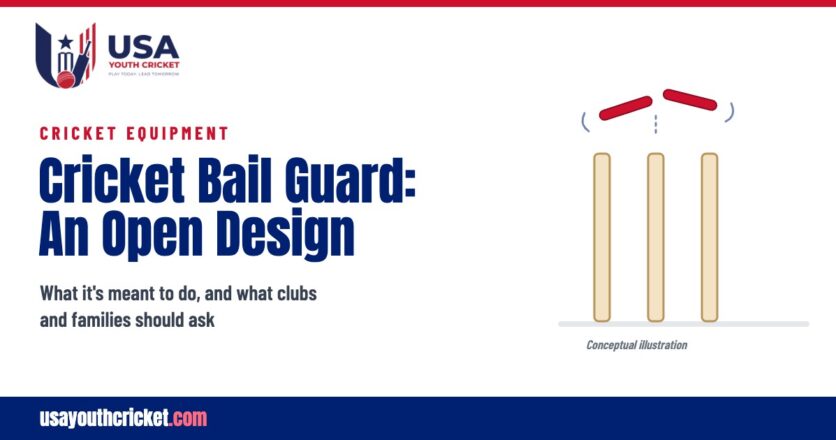
A freely published design tethers bails to the stumps. Here’s how the project says it works, what its numbers do and don’t show, and the questions grassroots clubs and families should ask.
Bails are the smallest pieces of equipment on a cricket field, and they spend most of a match sitting still. When the ball hits the stumps, they can fly. The MCC has allowed devices that limit how far a bail travels since 2017, as long as the governing body for the match and the ground authority approve them (ESPNcricinfo).
Cricket Bail Guard is a project, created by Aashi A. and Anish A., that has published one such design for anyone to use. Here’s what it says about itself, and what clubs should look at before deciding anything.
How it is meant to work
The project describes a tether linking each bail to a collar that slides on the middle stump. On impact, the bails lift as usual; the collar slides up to absorb the shock and limit how far the bails travel, then drops back into place. The project says a dismissal is given exactly as it would be without the device. The parts are meant to fit standard stumps and bails without drilling or permanent changes, and the project says they can be removed quickly.
Open by design
Rather than patent the idea, the project published it as a defensive publication on Zenodo under a Creative Commons Attribution 4.0 license. Its stated aim is to keep the mechanism free for anyone to build, sell or improve, and it says it sells nothing itself. The record includes the design document and a supplemental technical FAQ on bail mass and collar design. We haven’t evaluated the legal effect of the publication; making a design public isn’t a guarantee about patent rights.
Reading the numbers carefully
The project reports 5,894 bail-dislodging dismissals across 1,108 games between January 18 and October 18, 2026, taken from league scorecards in six U.S. states. Those figures measure how often a tethered bail would have come into play. The project states plainly that it makes no claim about injuries prevented, and we haven’t independently verified the totals. No governing body has certified the device.
Questions for clubs and families
- Is it approved for our matches? The Laws require approval from the governing body for the match and the ground authority.
- Who checks it? Someone should fit and inspect it before play, and know what to do if it comes loose.
- Does everyone know? Umpires, coaches and both teams should be told before the match.
- What does it not do? It doesn’t replace helmets, pads, wicketkeeping gear or umpires’ safety procedures.
- What does the evidence say? Read the project’s technical documents and ask what independent testing exists.
Sources
Project website: cricketbailguard.org. Design publication: Zenodo record 18646120. MCC’s 2017 change: ESPNcricinfo. Current Laws: MCC Laws of Cricket. The 2026 edition has been in force since October 1, 2026, and MCC’s summary of changes lists no change to the bail-device provision, but we could not open the full current text of Law 8; confirm the current text and your playing conditions.
Independent information: USA Youth Cricket is an independent resource. This is reporting, not an endorsement, safety certification or recommendation to install any device. Details may change; confirm rules, playing conditions and equipment requirements with your league, ground and governing body.